
Table des matières
Stocks vs ETFs: Which Investment Is Better?
Introduction
One of the most common questions new investors ask is: Stocks vs ETFs Which Investment Is Better?
Thank you for reading this post, don't forget to subscribe!Whether you’re building your first investment portfolio or looking to improve your long-term financial strategy, understanding the differences between stocks and ETFs is essential.
Both stocks and ETFs can help investors grow wealth over time, but they work differently and offer unique advantages and disadvantages.
In this complete guide, we’ll explore Stocks vs ETFs Which Investment Is Better, compare risks, returns, diversification, costs, and investment strategies, and help you determine which option aligns with your financial goals.

What Are Stocks?
Stocks represent ownership in a company.
When you buy a stock, you become a shareholder and own a small portion of that business.
Examples include shares of:
- Apple
- Microsoft
- Amazon
- Tesla
- Barclays
- HSBC
If the company performs well, your investment may increase in value.
Some companies also pay dividends, providing additional income.
Understanding how stocks work is the first step when evaluating Stocks vs ETFs Which Investment Is Better.
What Are ETFs?
ETF stands for Exchange-Traded Fund.
An ETF is a collection of investments grouped together into a single fund.
Instead of buying one company, investors gain exposure to many companies through one ETF.
Examples may include:
- S&P 500 ETFs
- FTSE 100 ETFs
- Global Equity ETFs
- Dividend ETFs
- Technology Sector ETFs
ETFs trade on stock exchanges just like individual stocks.
Many beginners prefer ETFs because they provide instant diversification.
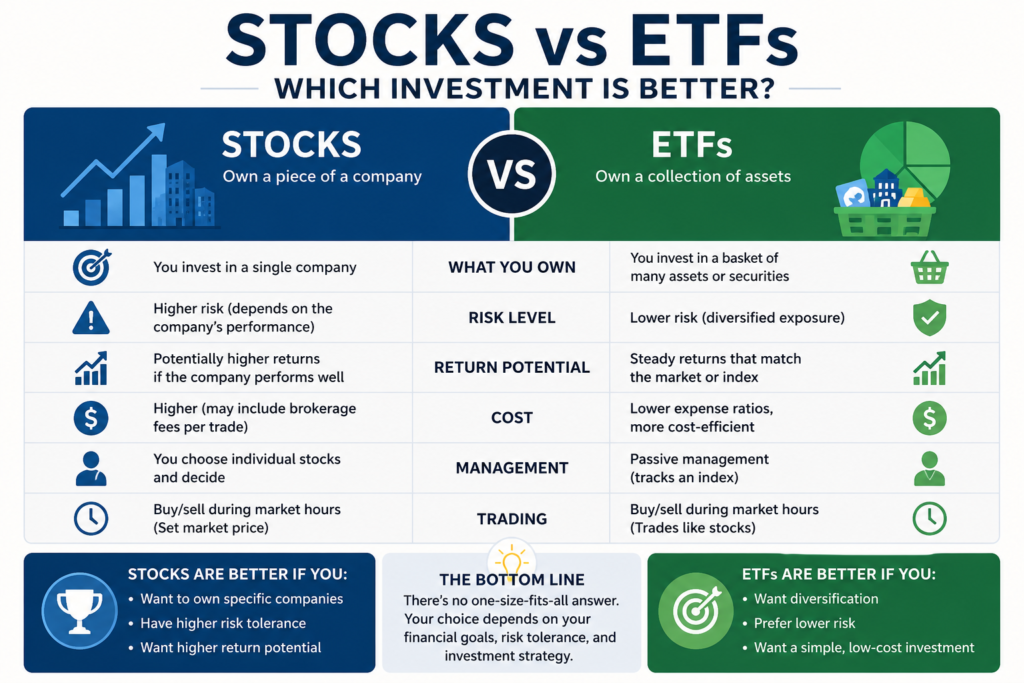
Stocks vs ETFs: Key Differences
1. Diversification
Actions
When you buy one stock, your investment depends largely on one company.
If that company performs poorly, your investment may suffer significantly.
ETF
ETFs typically hold dozens, hundreds, or even thousands of companies.
This diversification reduces company-specific risk.
Winner: ETFs
Diversification is one of the strongest arguments when considering Stocks vs ETFs Which Investment Is Better.
2. Risk Level
Actions
Individual stocks can be highly volatile.
Prices may rise or fall dramatically due to:
- Earnings reports
- Market sentiment
- Economic conditions
- Company news
ETF
Because ETFs spread investments across multiple assets, they tend to experience lower volatility.
Winner: ETFs
3. Potential Returns
Actions
Individual stocks may generate very high returns.
Examples of companies like Apple, Nvidia, and Amazon demonstrate how successful stock investments can create substantial wealth.
ETF
ETFs generally provide more moderate returns because gains are spread across many holdings.
Winner: Stocks
For maximum growth potential, stocks often have the advantage.
4. Ease of Investing
Actions
Researching individual companies requires time and knowledge.
Investors must evaluate:
- Revenue growth
- Earnings
- Competition
- Management quality
ETF
ETFs are simpler because professionals manage the fund structure.
Winner: ETFs
Many beginners researching Stocks vs ETFs Which Investment Is Better prefer ETFs due to simplicity.
5. Investment Costs
Actions
Many brokers now offer commission-free stock trading.
ETF
Most ETFs have management fees called expense ratios.
These fees are usually low but still exist.
Winner: Stocks
Advantages of Investing in Stocks
Stocks offer several benefits:
Higher Growth Potential
Exceptional companies can generate impressive returns.
Dividend Income
Many stocks distribute dividends to shareholders.
Ownership Rights
Shareholders may receive voting rights.
Flexibility
Investors can target specific companies and industries.
Advantages of Investing in ETFs
ETFs provide significant advantages:
Instant Diversification
One ETF may contain hundreds of companies.
Lower Risk
Diversification reduces company-specific exposure.
Simplicity
Ideal for beginners.
Lower Research Requirements
Investors don’t need to analyze every company individually.
For many investors evaluating Stocks vs ETFs Which Investment Is Better, these advantages make ETFs highly attractive

Stocks vs ETFs for Beginners
If you’re new to investing, ETFs are often considered a beginner-friendly option.
Reasons include:
- Reduced risk
- Diversification
- Simplicity
- Lower emotional investing
Many financial experts recommend starting with diversified ETFs before selecting individual stocks.
Stocks vs ETFs for Long-Term Investing
Long-term investors should consider:
Actions
Best for investors willing to:
- Research companies
- Accept higher risk
- Pursue higher returns
ETF
Best for investors seeking:
- Consistent growth
- Diversification
- Passive investing
When discussing Stocks vs ETFs Which Investment Is Better, the answer often depends on your goals and risk tolerance.
Dividend Stocks vs Dividend ETFs
Income-focused investors often compare dividend stocks and dividend ETFs.
Dividend Stocks
Advantages:
- Higher income potential
- Direct ownership
Disadvantages:
- Company-specific risk
Dividend ETFs
Advantages:
- Diversified dividend exposure
- Lower risk
Disadvantages:
- Slightly lower yields
Tax Considerations for UK Investors
UK investors may use:
- Stocks and Shares ISAs
- Self-Invested Personal Pensions (SIPPs)
These accounts can provide tax advantages for long-term investors.
For current tax rules, consult:
Common Mistakes Investors Make
Investing Without a Plan
Always establish clear financial goals.
Chasing Hot Stocks
Avoid emotional investing.
Ignoring Diversification
Concentrated portfolios increase risk.
Overtrading
Frequent buying and selling may reduce returns.
Not Understanding Risk
Invest only in assets you understand.
Can You Invest in Both?
Absolutely.
Many successful investors combine stocks and ETFs.
Example Portfolio:
- 70% ETFs
- 30% Individual Stocks
This approach offers:
- Diversification
- Growth potential
- Reduced risk
Many investors find this hybrid strategy ideal when considering Stocks vs ETFs Which Investment Is Better.
Helpful External Resources
For additional investing guidance:
MoneyHelper UK:
https://www.moneyhelper.org.uk
Financial Conduct Authority:
https://www.fca.org.uk
London Stock Exchange:
https://www.londonstockexchange.com
Investopedia:
https://www.investopedia.com
These resources provide educational information about investing, portfolio management, and financial planning.
Internal Linking Opportunities
Link to related articles:
- Investing for Beginners UK
- Personal Finance for Beginners UK
- How to Build an Emergency Fund from Scratch
- What Is a Good Credit Score in the UK?
- Best Cashback Credit Cards in the UK for 2026
Frequently Asked Questions
Are ETFs Safer Than Stocks?
Generally, ETFs offer greater diversification, which can reduce risk compared to individual stocks.
Can ETFs Make You Rich?
Over long periods, ETFs can generate substantial wealth through consistent investing and compound growth.
Should Beginners Buy Stocks or ETFs?
Many beginners start with ETFs due to simplicity and diversification.
Can I Own Both Stocks and ETFs?
Yes. Many investors combine both to balance growth and risk.
Final Verdict: Stocks vs ETFs Which Investment Is Better?
The answer depends on your investing goals, risk tolerance, and experience level.
Choose Stocks If:
- You enjoy researching companies
- You want higher growth potential
- You can tolerate volatility
Choose ETFs If:
- You want diversification
- You prefer passive investing
- You’re a beginner investor
For many investors, the best solution isn’t stocks or ETFs—it’s a combination of both.
Conclusion
When evaluating Stocks vs ETFs Which Investment Is Better, remember that there is no one-size-fits-all answer.
Stocks offer greater growth potential but higher risk. ETFs provide diversification, simplicity, and lower volatility.
For most beginners, ETFs are often the easiest starting point, while experienced investors may choose a blend of stocks and ETFs to maximize long-term returns.
By understanding the strengths and weaknesses of both options, you can build a portfolio that aligns with your financial goals and investment strategy.